The San Juan Islands for an Active Journey Between Kayaking, Lighthouses, and Whale Watching
The San Juan Islands are not the kind of destination that needs to shout. They sit quietly in the Salish Sea, between mainland Washington and Vancouver Island, offering a different rhythm from the famous national parks and long-distance mountain routes of the American West. Here, the landscape is not defined by one dramatic summit or one iconic viewpoint. It is built from water, forest, rocky shores, ferry crossings, small harbors, marine wildlife, and the soft patience of island travel. For active travelers, that is exactly the appeal. The San Juans invite movement, but not haste.
An active trip through the islands is less about covering maximum distance and more about changing perspective. One morning can begin on a kayak, close to the waterline, where seals surface nearby and the shoreline feels almost at eye level. The afternoon can move to a lighthouse trail, where the same sea opens wide below the cliffs. The next day may bring a ferry ride, a bike route, a forest walk, or a whale watching tour that turns the horizon into a place of expectation. The islands reward travelers who like variety but do not want every day to feel like a physical test.
The strongest symbol of the San Juan Islands is the meeting of land and water. Unlike mountain destinations, where the route often leads upward, the islands constantly lead outward. A road ends at a beach. A trail opens to a channel. A harbor becomes the starting point for a paddle. The geography encourages a slower form of adventure, where the traveler learns to read tides, weather, ferry times, and marine distance. Even a short journey can feel layered because movement here depends on more than walking or driving. The sea is part of the itinerary.
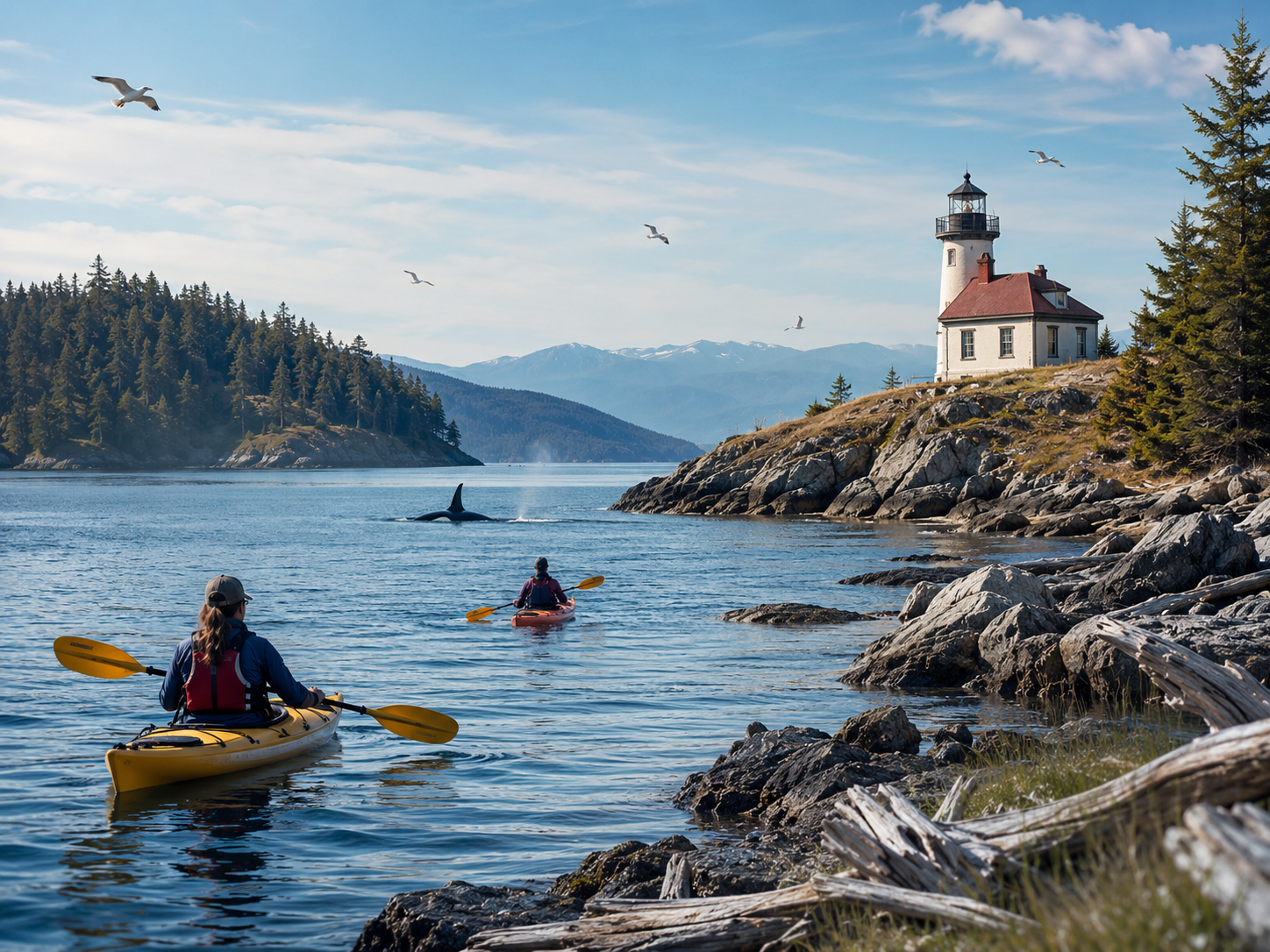
Kayaking is one of the most natural ways to understand the islands. From a kayak, the landscape becomes quieter and more detailed. Cliffs, kelp beds, driftwood, seabirds, and distant mountain silhouettes create a route that feels intimate without being small. Sea kayaking in this region is not simply a sport; it is a way of entering the scale of the place. The paddler moves slowly enough to notice changes in light, wind, and current. A bay that looks simple from shore becomes a living space filled with texture and motion.
That does not mean kayaking should be treated casually. The waters around the San Juan Islands can be calm and beautiful, but they are still marine waters with tides, currents, cold temperatures, and changing weather. For many visitors, a guided paddle is the best choice, especially if they are unfamiliar with sea kayaking. A guide can interpret the environment, choose a safe route, explain wildlife rules, and help travelers understand why distance on the water feels different from distance on land. The safest active travel is not the most extreme version. It is the version that respects the place.
Whale watching gives the islands another kind of movement. It is active in a different sense: less about physical effort and more about attention. The San Juan Islands are strongly associated with orcas, but the experience should not be reduced to a guaranteed sighting. The real value is learning to watch the water differently. A ripple, a dorsal fin, a gathering of birds, or a sudden change in the behavior of people on a boat can turn the sea into a field of signals. Even when whales do not appear, the experience can reveal the richness of the marine ecosystem.
Lime Kiln Point State Park on San Juan Island is one of the most memorable places for this kind of watching. Set on the island’s western shore, it combines rocky coastline, open water views, trails, and a lighthouse. It is often described as one of the best places to watch whales from shore, but its strength is not only the possibility of seeing wildlife. The park gives travelers a rare feeling of waiting with purpose. People stand along the rocks, look toward the water, listen, and scan the horizon. In a travel culture that often rewards constant motion, this kind of stillness can feel surprisingly active.
The lighthouse adds a historical and visual anchor to the route. Lighthouses are practical structures, but in island travel they also shape imagination. They mark the edge between safety and open water, between settlement and wilderness, between human navigation and natural force. Visiting a lighthouse on the San Juan Islands is not only about taking a photograph. It is about understanding how these islands have always been connected to movement, weather, visibility, and the risks of the sea.
For travelers who want to add land-based activity, the islands offer walking and cycling without the pressure of high-altitude performance. Roads pass farms, forests, small settlements, beaches, and viewpoints. Trails move through coastal parks and wooded areas rather than demanding long mountain ascents. This makes the San Juans especially attractive for mixed groups. One person may want to kayak, another may prefer a short hike, and another may be more interested in wildlife, photography, or local food. The islands allow these interests to meet without forcing everyone into the same kind of challenge.
Orcas Island adds a more elevated landscape to the experience. With forested roads, lakes, and viewpoints, it gives active travelers a different contrast to the open shorelines of San Juan Island. A hike or drive toward higher ground changes the perspective again. The archipelago becomes visible as a pattern of islands and channels rather than separate destinations. This shift from water level to high viewpoint is one of the pleasures of the region. The traveler sees the same place from several scales.
A good San Juan Islands itinerary should avoid the mistake of trying to turn the islands into a checklist. The ferry, the harbor, the slow lunch after a paddle, the quiet road to a viewpoint, and the wait near the lighthouse are not empty spaces between attractions. They are part of the trip. The islands work best when travelers leave room for weather, wildlife, and delay. A foggy morning may change a kayaking plan. A calm evening may become the best walk of the trip. A missed whale sighting may still lead to a memorable hour watching seals, birds, and light moving across the water.
This is why the San Juan Islands suit active travelers who are ready for a softer form of adventure. The experience is not passive, but it is not aggressive. It asks for movement, curiosity, and patience rather than speed. Kayaking brings the body close to the sea. Lighthouses connect the route to maritime history. Whale watching teaches attention and respect for wild animals. Trails and island roads fill the gaps with quiet discoveries.
In a region known for mountains, rainforests, volcanoes, and national parks, the San Juan Islands offer something more subtle. They show that active travel does not always need a dramatic conquest. Sometimes the strongest journey is built from small crossings: from land to water, from motion to stillness, from sightseeing to observation, from destination to rhythm. For travelers willing to slow down without becoming inactive, the San Juans can feel like one of the most rewarding outdoor experiences in the Pacific Northwest.